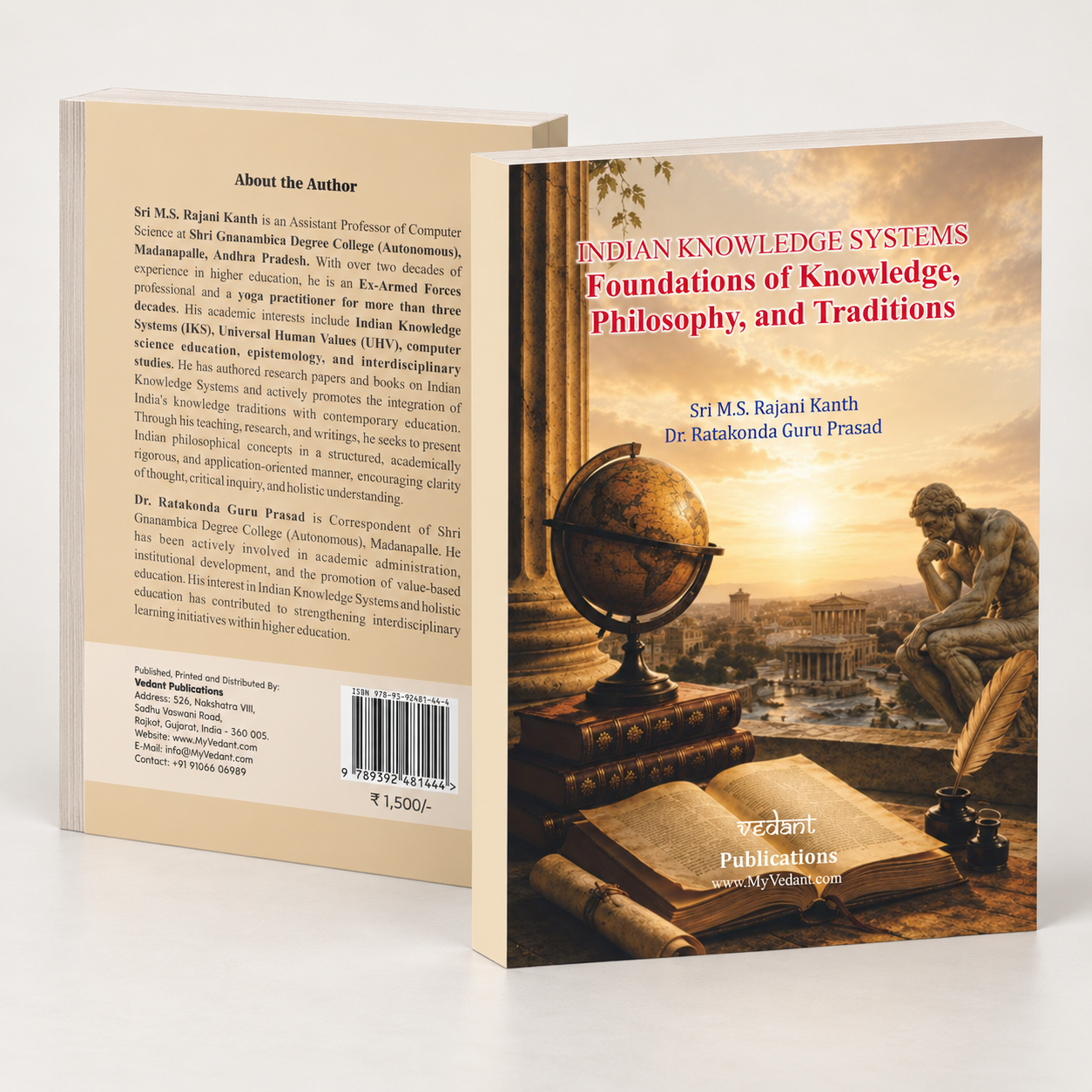
Description
Preface
This book is an introductory exploration of Indian
Knowledge Systems (IKS), designed to present foundational
concepts in a clear, structured, and accessible manner for
students. The objective of this text is to bridge the gap between
traditional knowledge frameworks and contemporary academic
learning by presenting core ideas in a systematic and applicationoriented
format.
The content of this book is organized into three chapters,
each addressing a key dimension of understanding. The first
chapter introduces the concept of knowledge from both general
and Indian perspectives, highlighting the progression from
information to wisdom and the deeper dimensions of Jnana and
Vijnana. It further explains fundamental concepts such as
Dharma, Karma, and Purusharthas, along with the Indian
worldview and human structure.
The second chapter presents the philosophical foundations
through the study of the Shatdarshanas, the six classical systems
of Indian philosophy. It explains their individual contributions
and their complementary nature. The chapter also introduces
Yoga as a practical discipline for self-development and wellbeing,
along with the basic principles of Ayurveda as a system of
health rooted in balance and harmony.
The third chapter focuses on Indian knowledge traditions,
including traditional education systems such as the Gurukul,
ancient centers of learning, and the structure of Vedic literature. It
also highlights the role of Itihasas and the Bhagavad Gita in
conveying ethical and philosophical understanding. In addition,
the chapter introduces basic concepts of Indian astronomy and
time systems, emphasizing observation of nature and its
application in daily life.
This book aims to provide a balanced understanding that
integrates inner development and practical knowledge,
encouraging students to relate these concepts to their own lives.
The presentation is kept simple and concept-oriented, without
unnecessary complexity, so that learners can develop clarity,
reflection, and meaningful application.
It is hoped that this text will serve as a useful resource for
students and educators in understanding the relevance of Indian
knowledge traditions in contemporary education and life.


Reviews
There are no reviews yet.