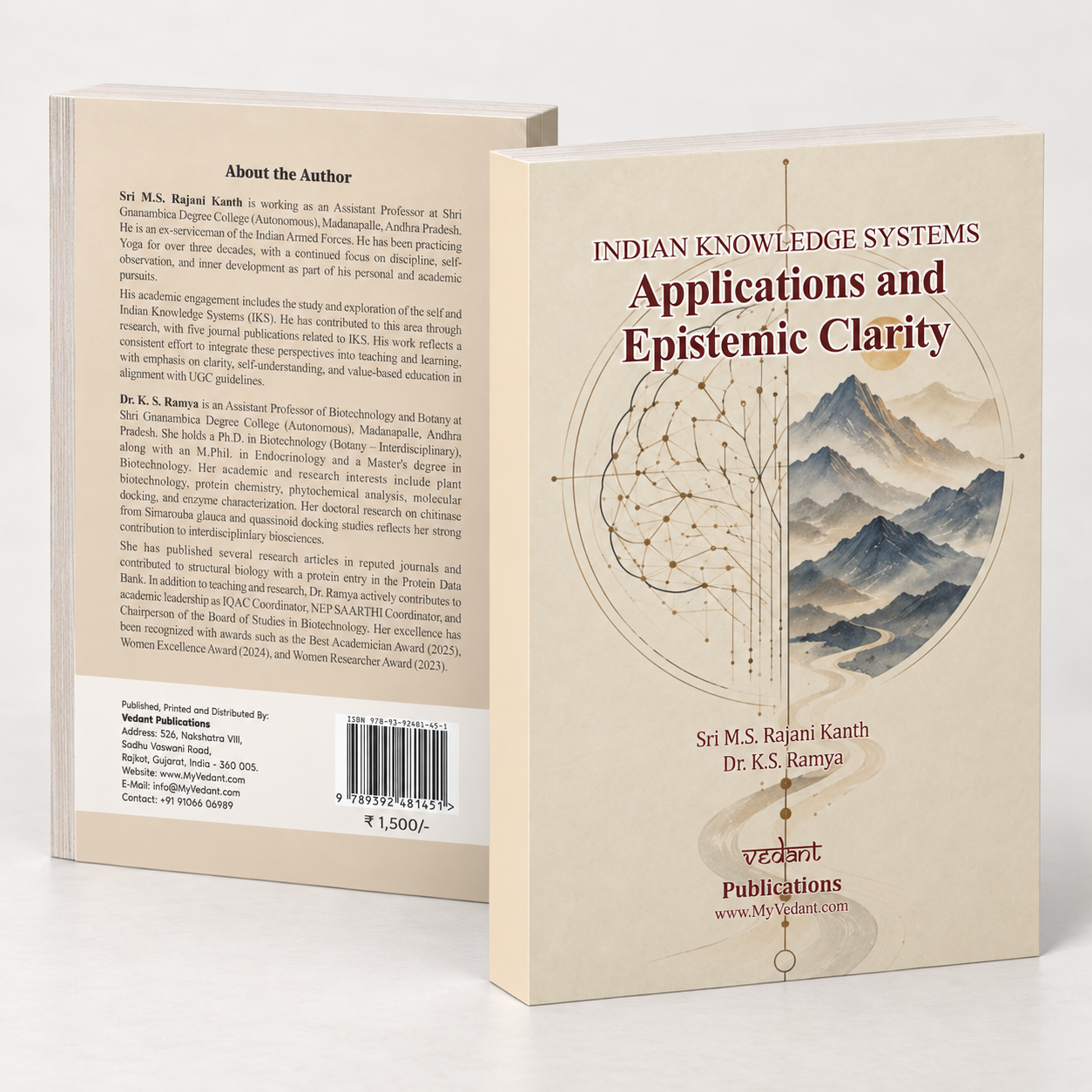
Description
Preface
This book is a continuation and deepening of the exploration of
Indian Knowledge Systems (IKS), moving from introductory
understanding to applied clarity in human life. While the first
volume presents foundational concepts, the present text focuses on
how these principles operate in lived experience—through
thought, action, understanding, and cultural expression.
The objective of this book is not merely to present concepts, but to
enable a shift from information to clarity, and from clarity to
application. It addresses the gap that often exists between knowing
and living by examining how fundamental ideas such as Dharma,
Karma, knowledge, and cultural practices function within
everyday life.
The content is organized into three units, each representing a
progressive movement in understanding. The first unit examines
Dharma and Karma in the context of human life systems,
emphasizing the distinction between bodily identity, conceptual
identity (Ahambhava), and the actual self (Aham). It presents
Dharma as a context-based responsibility aligned with the natural
order and explains Karma as a continuous process that shapes
experience. The unit further addresses the source of inner conflict
and the role of observation and understanding in developing
clarity.
The second unit focuses on epistemic clarity— understanding the
process of knowing itself. It highlights the importance of epistemic
position and distinguishes between Jnana (clarity of role and
appropriateness) and Vijnana (skill and expression). The unit
examines mechanisms of misalignment, such as cross-framework
interpretation and loss of context, and discusses their
consequences in knowledge systems, education, and life. It also
presents methods for restoring clarity through the integration of
knowledge, contextual understanding, and holistic frameworks.
The third unit presents cultural practices as structured expressions
of knowledge rather than isolated rituals. It examines practices at
multiple levels—body, environment, and meaning—and explains
their functional basis in alignment with natural processes.
Concepts such as Vigraha Aradhana, Pradakshina, and Pitru are
presented not as matters of belief, but as expressions of continuity,
both within life and beyond the physical body. The unit
emphasizes that cultural practices serve as mechanisms for
sustaining alignment, experience, and continuity across
generations.
A key perspective maintained throughout this book is that these
principles are not confined to any one culture or belief system, but
reflect underlying laws of nature. Indian traditions are presented as
one of the structured systems that have preserved and transmitted
this understanding over time. The intention is to study these
practices within their own framework, rather than interpreting
them solely through external or fragmented approaches.
The presentation is intentionally concept-oriented, with emphasis
on clarity, observation, and application. The aim is to encourage
students not only to understand the material intellectually, but to
relate it to their own experiences and actions. In doing so, the text
seeks to support the development of responsible living, informed
decision-making, and integrated understanding.
It is hoped that this book will serve as a meaningful resource for
students and educators, contributing to a deeper engagement with
Indian Knowledge Systems as a living and applicable framework
for understanding life.


Reviews
There are no reviews yet.