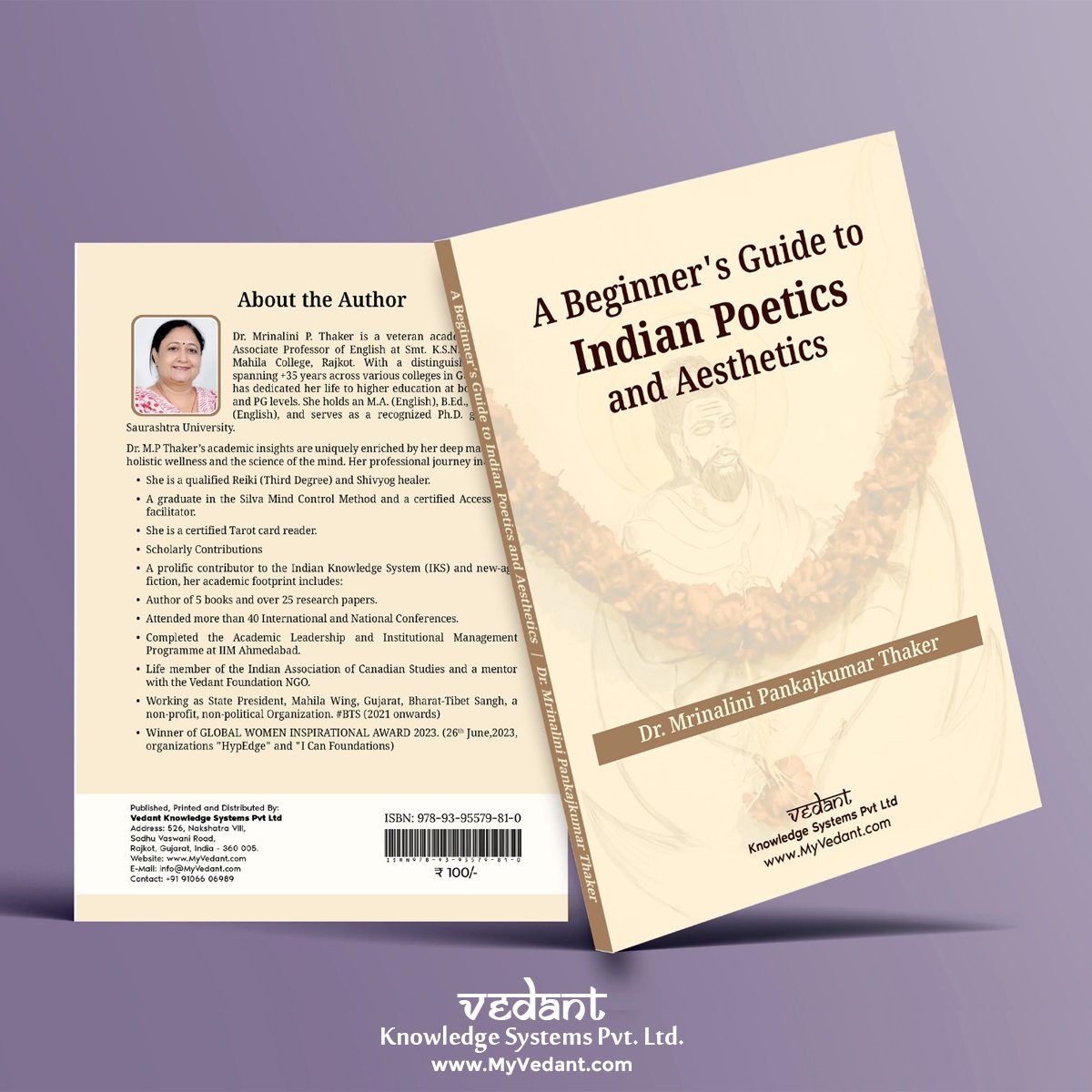
Description
E-Book on A Beginner’s Guide to Indian Poetics and Aesthetics
Preface
Indian poetics offers one of the world’s most sustained and subtle inquiries into how literature creates meaning, feeling, and aesthetic pleasure. From the earliest reflections on drama and performance to later philosophical accounts of suggestion and readerly experience, Sanskrit literary theory develops not as a single linear doctrine but as a rich conversation across centuries – one in which each school clarifies the aims of art while responding to the limitations of earlier explanations. This book is written to introduce that conversation in a structured, student-friendly manner.
Indian poetics is, at its heart, a sustained inquiry into what literature does to us – how language, imagination, and emotion converge to produce aesthetic delight. This book offers an accessible introduction to the major frameworks of classical Indian (Sanskrit) poetics, presented in a sequence designed especially for readers trained in English literary studies, as well as for students approaching these ideas for the first time.
While the book follows a historical progression, it does not treat history as mere chronology. The goal throughout is to make concepts usable for reading literature. For that reason, each chapter emphasizes definitional clarity, key debates, and interpretive consequences, what changes in our understanding of a poem when we adopt one framework rather than another. Readers are encouraged to approach these theories not only as “ancient doctrines” but as living tools for criticism: rasa as a model of affective experience, alaṅkāra as craftsmanship and patterned beauty, rīti as stylistic identity, dhvani as resonance beyond explicit sense, vakrokti as creative deviation, and the later syntheses as mature accounts of how language, imagination, and aesthetic experience converge.
As a student of English literature, these theories initially felt difficult-densely technical, conceptually layered, and culturally distant from the critical vocabulary used in many English classrooms. That early struggle became the motivation for this project: to present the central ideas of Indian poetics in an accessible, classroom-friendly format, without losing their intellectual depth. What began as lecture notes and discussions with my class gradually took the shape of structured chapters and was eventually prepared for publication so that the material could be useful beyond a single semester and for general readers as well as students.
The book moves step-by-step through the key schools and their representative thinkers: an introduction to Indian poetics; Bharata’s Rasa theory; Bhāmaha’s Alaṅkāra theory; Rīti/Mārga in Daṇḍin and Vāmana; Ānandavardhana’s Dhvani theory; Kuṇṭaka’s Vakrokti theory; Abhinavagupta’s Rasa–Dhvani synthesis; and finally Mammaṭa’s Kāvyaprakāśa, a foundational compendium that gathers and systematizes many earlier debates. The aim throughout is practical clarity – helping readers understand what each theory claims, why it matters, and how it can sharpen the act of reading.
This work is intended for general readers with an interest in aesthetics and literary criticism, as well as for undergraduate and postgraduate students who need a reliable conceptual guide. Each chapter is written to function both as an introduction and terms are explained carefully, arguments are presented in plain language, and the overall structure is kept deliberately teachable.
Finally, this book remains open to improvement. As a teacher of English literature, I may have made errors in my understanding of the vast knowledge that Indian aesthetics has to offer. As such, I am still learning, and I warmly welcome suggestions and corrections from readers.
Dr Mrinalini Pankajkumar Thaker (Mansotra)
Associate Professor
Smt. KSN Kansagara Mahila College, Rajkot
Reviews
There are no reviews yet.