• Publication Assurance in SCOPUS, PubMed, Web of Science, Embase, and Google Scholar-indexed journals (As per UGC Suggestive Parameters)
• Paper and Author Indexing Assurance
• Publication options: Regular Issue and Special Issue
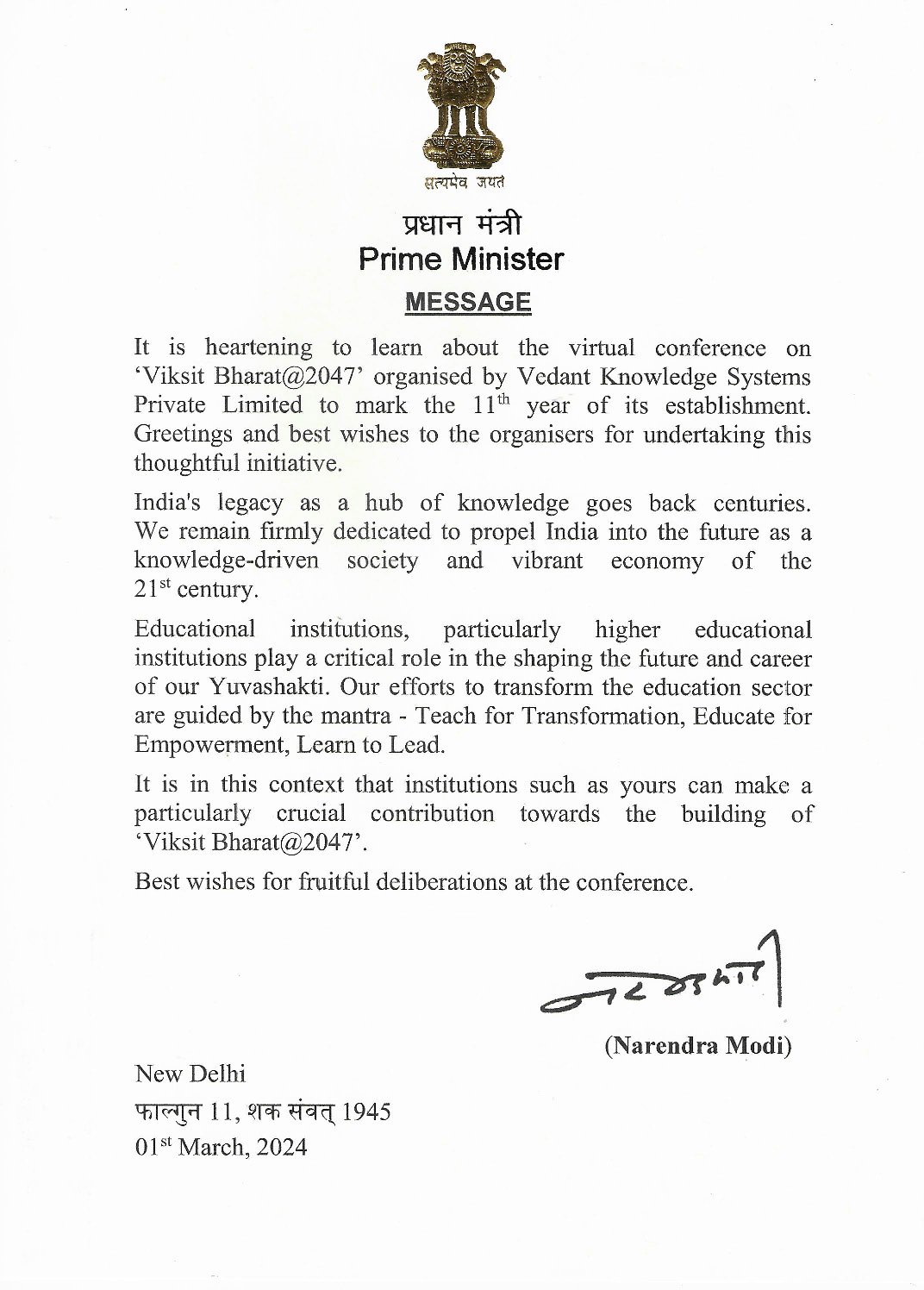
Our Honourable Prime Minister, Shri Narendra Modi ji, appreciated Team Vedant for completing 10 years of service in nation-building and for providing a platform for Viksit Bharat @ 2047.
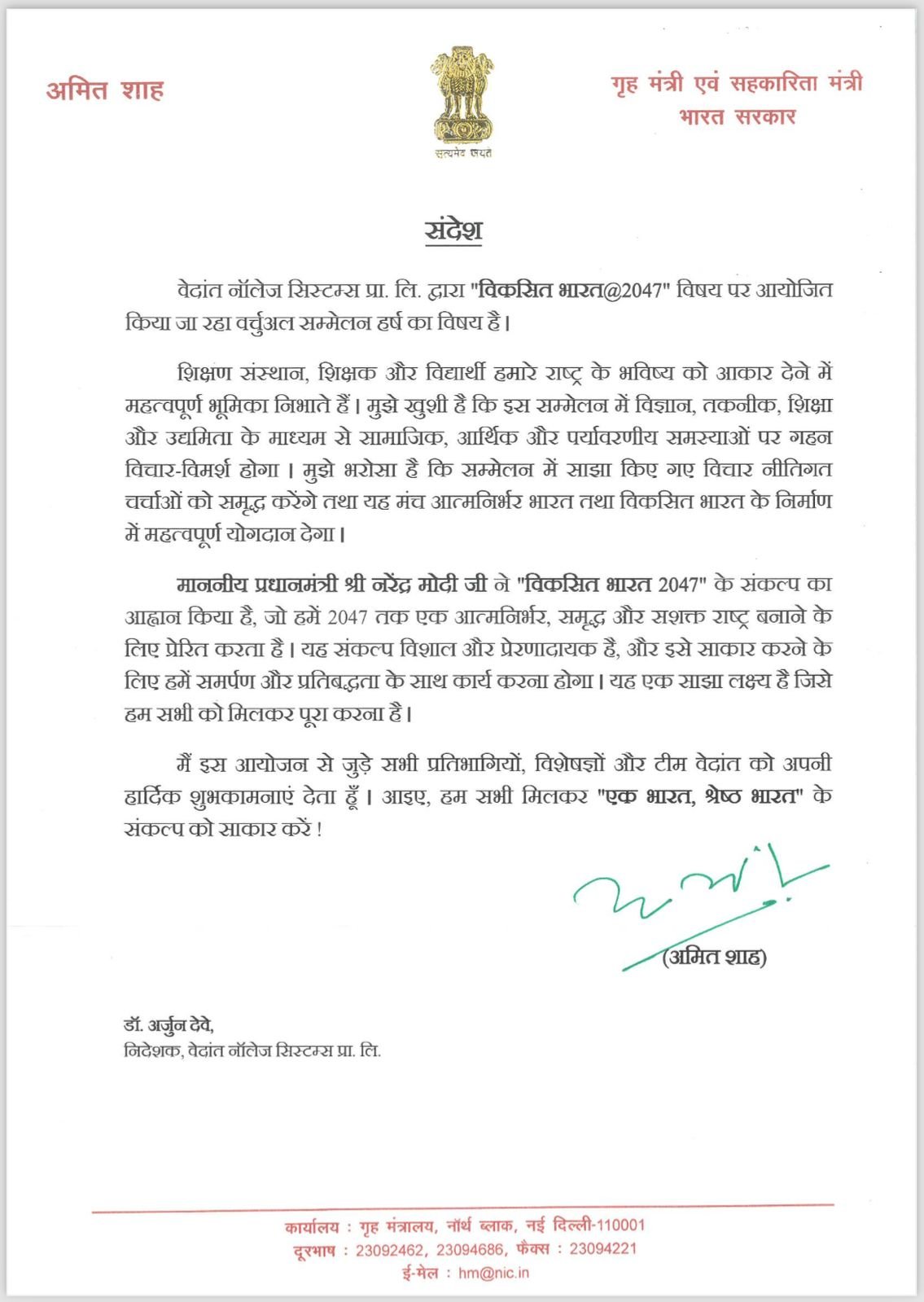
Our Honourable Home Minister, Shri Amitbhai Shah, appreciated Team Vedant for its service in nation-building and for providing a platform for Viksit Bharat @ 2047.
Major Themes and Sub-Themes
The following is a suggestive list. Your submission may be different from the list but related to the title of the conference.
1. NEP 2020 and Structural Transformation of Higher Education
i. Restructuring curricula, pedagogy, and assessment in line with NEP 2020.
ii. Multidisciplinary and holistic learning models across Sciences, Humanities, and Professional Studies.
iii. Institutional governance, accreditation, and autonomy for excellence.
iv. Role of Academic Bank of Credits, Choice-Based Credit Systems, and Outcome-Based Education.
v. Implementing NEP 2020 through inclusive and participatory university models.
2. Indian Knowledge Systems (IKS) — The Civilizational Foundation of Modern Education
i. Philosophical and scientific wisdom of ancient India in contemporary pedagogy.
ii. Integration of Gurukul learning ethos into teacher education and value-based curriculum.
iii. Application of Ayurveda, Yoga, Vastu Shastra, and Arthashastra across disciplines.
iv. Indic psychology, ethics, and sustainable practices in modern research.
v. Reviving Sanskrit and regional languages as instruments of higher learning.
3. Science, Technology, and Engineering for Viksit Bharat
i. Indigenous innovations in renewable energy, nanotechnology, and environmental engineering.
ii. Leveraging Artificial Intelligence, IoT, and robotics in education and research.
iii. Integration of traditional scientific methods with modern experimentation.
iv. Green technologies and sustainable engineering aligned with Atmanirbhar Bharat.
v. Promoting interdisciplinary STEM education rooted in ethical and ecological consciousness.
4. Medicine, Ayurveda, Pharmacy, and Health Sciences
i. Integrating modern medicine with Ayurveda and Yoga for holistic health.
ii. Research collaboration between biomedical sciences and traditional systems.
iii. Value-based healthcare education emphasizing compassion and ethics.
iv. Pharmaceutical innovations and herbal medicine validation through evidence-based research.
v. Physiotherapy and paramedical sciences in preventive and rehabilitative health education.
5. Commerce, Economics, and Management for Sustainable Growth
i. Dharma-driven business ethics and corporate governance.
ii. Start-up ecosystems and innovation incubation within universities.
iii. Entrepreneurship education for Atmanirbhar Bharat and rural empowerment.
iv. Integration of financial literacy, economic justice, and sustainability in curricula.
v. Management philosophies inspired by Kautilya’s Arthashastra and Gandhian economics.
6. Social Sciences, Humanities, and Liberal Arts for National Regeneration
i. Reinterpreting Indian society through postcolonial and Indic perspectives.
ii. Education for social harmony, cultural continuity, and democratic values.
iii. Role of political science, sociology, and economics in shaping ethical governance.
iv. Liberal arts as the foundation of creativity, critical inquiry, and civic consciousness.
v. Human rights education and inclusive policy design for equitable development.
7. Law, Policy, and Good Governance
i. Integration of Dharma Shastra ethics with modern legal frameworks.
ii. Environmental law and justice through Indic ecological principles.
iii. Cyber law, digital rights, and AI regulation in higher education systems.
iv. Legal literacy, justice access, and citizen empowerment through education.
v. Constitutionalism, equity, and ethics in policy-making for higher education.
8. Education, Teacher Development, and Pedagogical Innovations
i. Reimagining teacher education through Indic values and global pedagogy.
ii. Role of educators in holistic personality development and value transmission.
iii. NEP 2020’s focus on early childhood and higher education continuity.
iv. Integration of digital pedagogy, experiential learning, and emotional intelligence.
v. Empowering teachers as nation builders and ethical leaders.
9. Agriculture, Environment, and Sustainable Development
i. Revival of traditional agricultural wisdom and eco-friendly practices.
ii. Agro-innovation, food security, and organic farming through research and policy.
iii. Rural universities as engines of local development and self-reliance.
iv. Environmental ethics rooted in Prakriti and Indian cosmology.
v. Sustainable water management, biodiversity conservation, and green education.
10. Architecture, Design, and Aesthetic Sustainability
i. Vastu Shastra and Indian aesthetics in modern architectural education.
ii. Sustainable urban design and eco-sensitive infrastructure.
iii. Indigenous materials and traditional crafts in modern design pedagogy.
iv. Art, design, and creativity as vehicles of cultural expression and innovation.
v. Performing and visual arts education for emotional and cultural development.
11. Information, Library, and Digital Knowledge Systems
i. Digitization of Indian manuscripts and cultural archives.
ii. Knowledge management and open-access academic ecosystems.
iii. Role of library science in preserving and disseminating IKS resources.
iv. Integration of AI and data analytics in information science.
v. Promoting digital literacy, academic integrity, and inclusive access to knowledge.
12. Physical Education, Yoga, and Holistic Well-Being
i. Yoga and traditional sports as foundations of physical and mental fitness.
ii. Integrating Khel Sanskriti (sports culture) into academic life.
iii. Physical education as a medium for leadership, discipline, and mindfulness.
iv. University-level wellness programs inspired by Indian health philosophy.
v. Sports and yoga education for character formation and national vitality.
13. Journalism, Mass Media, and Cultural Communication
i. Media ethics and truth-telling grounded in Indic moral values.
ii. Communication for social transformation and civic engagement.
iii. Role of media in preserving and globalizing Indian heritage.
iv. Digital journalism and content authenticity in the AI era.
v. Performing arts and storytelling as instruments of moral education.
14. Tourism, Hospitality, and Cultural Diplomacy
i. Heritage and spiritual tourism as tools for global cultural exchange.
ii. Hospitality education rooted in Atithi Devo Bhava ethos.
iii. Sustainable tourism models aligned with SDGs and NEP 2020.
iv. Role of tourism in rural livelihood generation and cultural revival.
v. Integration of heritage management and education for cultural sustainability.
15. Social Work, Community Development, and Inclusive Growth
i. Education as a tool for social justice and empowerment.
ii. Role of social work in community mobilization and policy advocacy.
iii. Indigenous models of welfare and community service.
iv. Higher education’s contribution to nation-building through civic participation.
v. Volunteerism, youth leadership, and education for social transformation.
Research Questions
The following is a suggestive list. Your submission may be different from the list but related to the title of the conference.
Download Research QuestionsSuccessfully Published Papers to Date
Conference Participants So Far
Conference Highlights
Proud Participants
- These are the visionary academicians and researchers whose contributions will be counted in the making of Viksit Bharat @ 2047.
- These are the people who are proud to be Indian.
- Team Vedant thanks the following participants and wishes them all the very best in their future endeavours.
Fees
- You will receive a Certificate of Participation.
- You will receive a Certificate of Presentation.
Publication
SCOPUS, Web of Science, and PubMed offer both Open Access and Subscription-Based publication options.
Embase, Google Scholar, and Peer-Reviewed platforms offer Open Access publication only.
Selection Process & Support
- The name of the journal will be provided once we receive your subject, research paper title, and abstract.
- All necessary guidelines will be provided in person to help make your paper suitable for the selected journal.
Awards
All awards include a certificate, a memento, and national recognition.
Session Chair
Meet the proud Bharatiya academicians who will be guiding the Viksit Bharat@2047 Conferences as Session Chair Experts.
Session Chair ListBecome a Session Chair
Academicians are invited to participate in this conference as Session Chairs. This is a prestigious opportunity to lead academic discourse.
Session Chair RegistrationContact Us
Visit
526, Nakshatra VIII, Sadhu Vaswani Road,
Rajkot, Gujarat, India – 360005
🕙 10 AM to 8 PM (IST)
📅 Monday to Saturday
View LocationFor Institutional Support & Indexed Journal Consultation
Contact Director
🕙 10 AM to 8 PM (IST)
📅 Monday to Saturday
Call Now
Total Visitors: 1470
Today's Visitors: 3